Every feature is tied to a specific moment on a specific set where the author needed something and didn't have it.
"Console just died. Gaffer wants a look in 5 minutes."
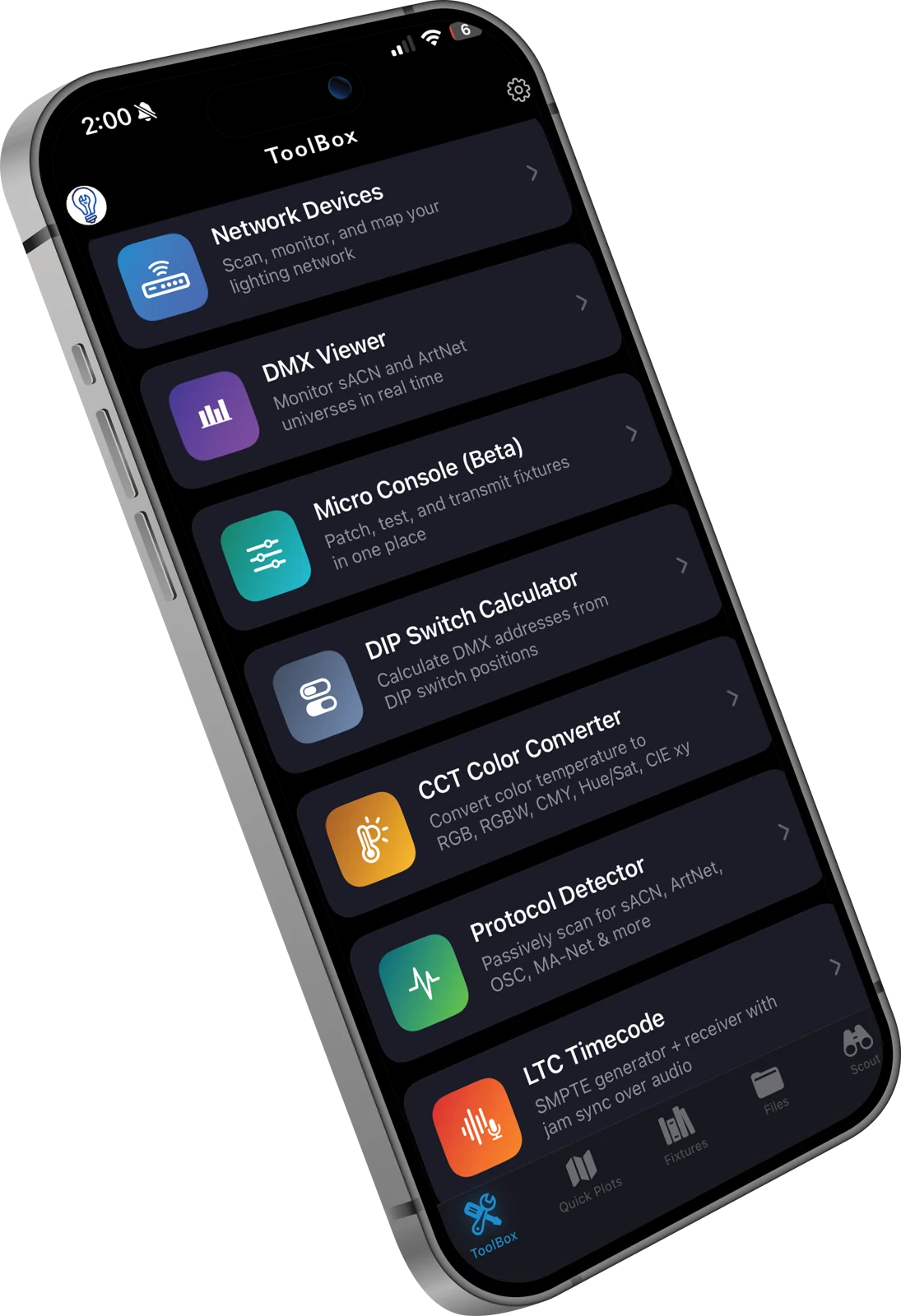
Micro Console takes the rig over sACN or ArtNet from your iPad — priority-aware, GDTF-patched.
"DMX is dropping. Is it the console, the node, or the cable?"
DMX Viewer reads sACN and ArtNet live across 100+ universes. Protocol Detector finds conflicts.
"Forty new fixtures just rolled in. Addresses due on paper."
DIP Switch Calculator and the Fixture Library get you from crate to printed sheet in ten minutes.
"Rigging gaffer emailed a network drawing. Which IP is which node?"
Network Scanner with saved scan profiles and XLSX label import tells you before you leave the truck.
"I'm on a scout. My notebook just got rained on."
Scout Notes keeps photos, markup, voice memos, and a GPS map pinned to one folder you can PDF out.
"LED wall isn't tracking on the ramp."
Curve Builder pulls a 256-point calibration from lux readings and exports direct to grandMA3 or MagicQ.
No feature bloat. No committee-designed UI. No ad SDKs. Built lean because every feature has to earn its spot on a working tech's phone.
Full subnet discovery with saved scan profiles, ping monitoring with background push alerts, and pre-scan device labeling via XLSX or CSV.
Monitor live sACN (E1.31) and ArtNet across 100+ universes, snapshot the state of a running show, and catch phantom signals and priority conflicts.
A pocket control surface that takes over a lighting rig directly from an iPad via sACN or ArtNet. Full GDTF patching, per-attribute masters, animated testers.
Visual 8- and 10-switch DIP calculator for any starting address. Prep a bag of new fixtures in minutes, not hours.
Convert color temperature to RGB, CIE xy, and hue/sat via the ASC White Point lookup table. Save user presets for fixtures you use often.
Passive listener for sACN, ArtNet, Pathport, MA-Net 2/3, HogNet, ETCNet, and OSC with automatic conflict detection and snapshot export.
Both ArtRDM and sACN-RDMnet LLRP transports. Discover, label, address, and identify fixtures on the wire.
Generate and read SMPTE LTC across all four frame rates with Off, Jam Once, and Continuous chase modes.
In-field dimmer and color calibration with direct export to grandMA3 XML, ChamSys MagicQ CSV, and PDF reference sheets.
Discover and view NDI video sources on your network. Transmit your iPhone camera as an NDI source, screenshot frames, record clips.
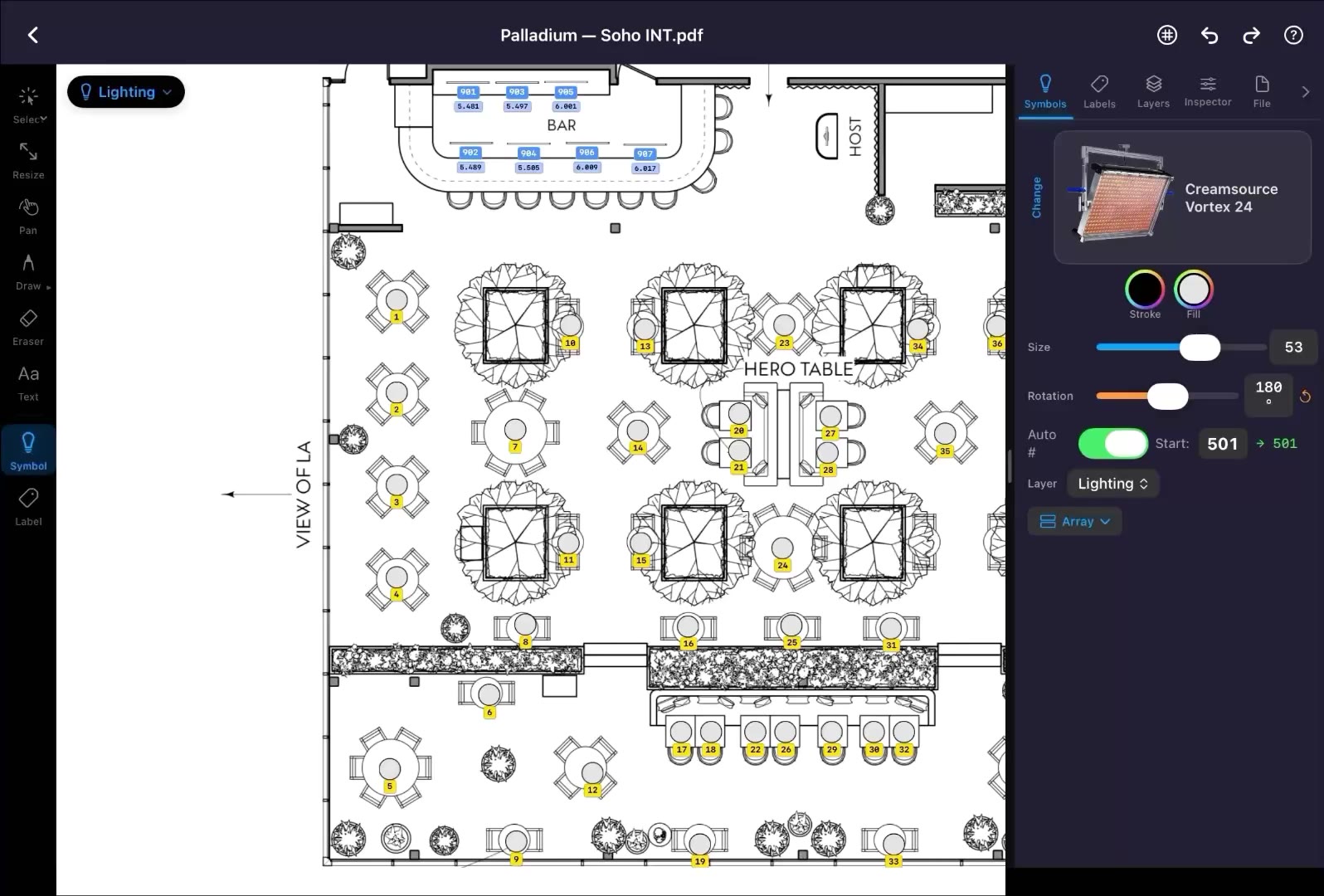
iPad-native lighting plot and network topology editor. Drop a scout photo or a satellite map as background, place symbols, run cables, export PDFs.
8,000+ fixtures from 1,000+ manufacturers via GDTF Share. Search, favorite, download, and use in Quick Plots or the Micro Console patch sheet.
Location scout companion — photos with PencilKit markup, voice memos, block-based notes, GPS-tagged map preview, branded PDF export.
The vocabulary is different, the gear is different, the problems rhyme.
One tap → live DMX across all 512.
Another tap → every device on the stage's network.
Another tap → full GDTF spec sheet.
Sketch a topology on the train.
Verify DMX at the house.
Look up photometrics mid-tech rehearsal.
Micro Console + RDM Tier 1.
Protocol Detector across 8 protocols.
SMPTE LTC generator + receiver.
Not a replacement for an Eos or an MA3. A pocket control surface for the "programmer stepped away" and "the board just ate itself" moments every working tech has.
Not a Vectorworks or LightWright replacement. A drafting pad for the train, the scout, the stage, the prep bench — the places where a full desktop workflow is overkill.
Photos with pencil markup, voice memos, block-based notes, GPS-tagged map preview, file attachments — all wrapped into a branded PDF you can hand to a producer or a gaffer.
The hardest part of building a tool for working techs is saying no to features that look cool but don't actually help anyone.
"I'm a working lighting programmer." I built StageTools because I kept showing up to set with a bag of half-working tools and a laptop I didn't want to pull out.
The app doesn't try to replace a full console for a big show. It replaces the bag of single-purpose tools a working tech has to carry — the scope, the cable tester, the handheld DMX tester, the network scanner, the fixture catalog. Every feature is tied to a specific moment on a specific set where I needed something and didn't have it.
The hardest thing isn't writing the code. It's saying no to features that look cool but don't actually help a working tech.
All network reads are local and read-only. Nothing leaves your device unless you turn on iCloud Sync, and then it only goes to your own iCloud account. No analytics. No crash reporting. No ads. No tracking. Ever.
TestFlight beta is open to working lighting crews — film, theater, touring. Free for testers. App Store launch in 2026.
Join TestFlight Beta